Pull up three listings this week, one in Royal Harbor, one in Aqualane Shores, one in Port Royal, and the first paragraph will read almost the same in each: direct Gulf access, no bridges, private dock, boat lift. The sentence appears in a listing priced near $4 million and again in one priced near $15 million. That should stop a comparison shopper cold. In a market where every dollar is supposed to be buying something specific, this particular sentence is apparently for sale at three very different price points, and the listing copy never explains why.
The honest answer isn't prestige, and it isn't proximity to the water. It's canal geometry, and right now, a city dredging project that's still finishing up. If you're weighing Royal Harbor against its two more expensive neighbors, that distinction matters more than the median price you've already seen.
The Gap the Price Sheet Doesn't Explain
Here's what the three neighborhoods actually looked like this year, using the most recent figures available for each:
| Neighborhood | Price Signal | Time Window |
|---|---|---|
| Royal Harbor | Median list price for single-family homes near $3.95 million, averaging roughly $1,660 per square foot | June 2026 |
| Aqualane Shores | Average closed sale price of $9.775 million across 32 single-family sales; median sale price near $8.6 million for the trailing three months | 2025 closings / three months ending June 2026 |
| Port Royal | Average home value near $14.75 million, up about 5.9 percent year over year | June 2026 |
That's roughly a four-to-one spread between Royal Harbor and Port Royal, and all three neighborhoods are making the same core claim on their listing sheets: no bridges between the dock and the Gulf. If the claim were the whole story, the prices would track more closely than this. They don't, because "no bridges" only answers one question about the water, and it isn't the question that determines whether your boat fits.
What "No Bridges" Doesn't Promise
"No bridges" is a statement about vertical clearance. It tells you a fixed span won't cap your mast height or your T-top on the way to Gordon Pass. It says nothing about canal width, turning radius, or depth at low tide, and those three factors are where Royal Harbor and Port Royal genuinely diverge.
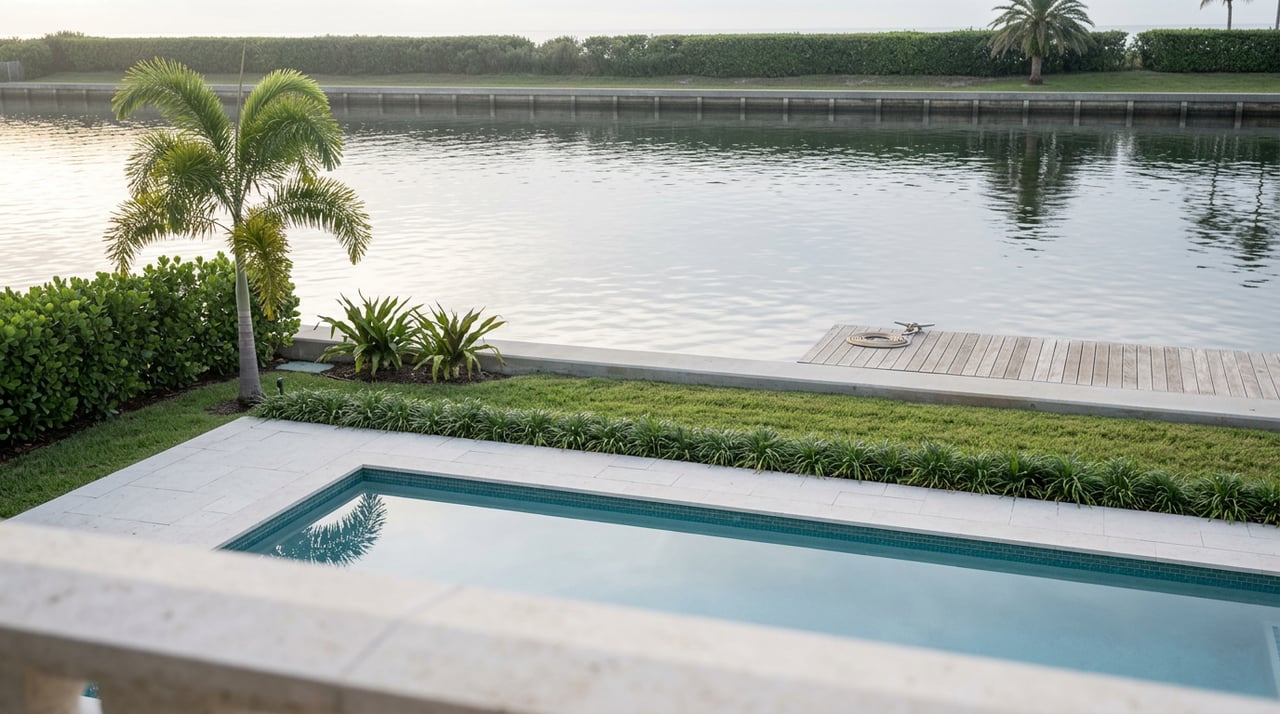
Port Royal's canals frequently run past 100 feet wide, engineered from the start for large motor yachts and deep-keeled sailboats with room to turn. Royal Harbor's canal system feeds into a wider main channel off Naples Bay, but the finger canals serving individual lots are narrower, with tighter turning basins. A boat that clears every bridge on the way to the Gulf can still be the wrong boat for a specific dock if the turning basin doesn't give it room to swing.
"No bridges" answers whether your mast clears the pass. It doesn't answer whether your beam clears the basin two doors down from your dock.
That's the gap a buyer needs to close before comparing price tags, because the same marketing phrase is doing different work in each neighborhood. In Port Royal, it's describing water built for scale. In Royal Harbor, it's describing water built for access at a more attainable price, with real limits on vessel size that the phrase alone doesn't disclose.
The Dredging Project That's Still Finishing This Year
There's a second layer to this that has nothing to do with original canal design and everything to do with maintenance, and it's happening right now.
Royal Harbor's canals, along with those in neighboring Golden Shores and Oyster Bay, fall inside the East Naples Bay Special Taxing District, a district Naples residents created by referendum back in 1987 specifically to fund water quality and navigability work in these waterways. The current dredging and rock removal project under that district has been running for years longer than planned. Hurricane Ian pushed a significant amount of new sediment and debris into the canals in 2022, forcing the city's contractor to re-survey the entire system before work could resume. Dredging restarted in September 2023 and has since moved canal by canal, generally starting in the north near Naples Bay Resort and progressing south toward Royal Harbor. As of the most recent city timeline, completion was targeted for mid-2026, which puts Royal Harbor's canals among the last in the sequence to be finished. You can review the district's own description of its scope on the City of Naples' East Naples Bay Special Taxing District page and check current capital project status on the city's active projects list.
What that means for a buyer today: not every canal in Royal Harbor has been dredged on the same schedule, and depth at your specific dock depends on where in that north-to-south sequence your canal falls. A home two streets apart from another can have meaningfully different water depth simply because one canal was worked on in 2024 and the other is only now being finished.
Before you treat any Royal Harbor listing's water access as settled, it's worth confirming a few specifics rather than taking the phrase at face value:
- Which canal the dock sits on, and whether that canal has been dredged under the current city project or still awaits it
- Measured depth at mean low water, not just at high tide, and the date that measurement was taken
- Whether the seller has had any private dredging done independently of the city project
- Your own vessel's beam and draft against the width of the specific canal and its turning basin, not the neighborhood's general reputation
What This Means If You're Comparing Neighborhoods Right Now
Once you separate the marketing phrase from the mechanics, the price gap between these three neighborhoods stops looking like a mystery and starts looking like a fairly rational market pricing a genuine engineering difference.
If your boat is a center console, a bay boat, or a midsize cruiser under roughly 30 to 35 feet, Royal Harbor's canals were built to accommodate exactly that kind of vessel, and the neighborhood's price tier reflects a real, attainable version of Gulf access rather than a discounted one. You're not settling for less water. You're paying for water sized to a different kind of boat.
If you're shopping for a wide-beam motor yacht or a deep-draft sailboat, the premium in Port Royal isn't paying for a nicer version of the same thing Royal Harbor offers. It's paying for water engineered at a different scale, plus the deepest, most consistently maintained canals in the market. Aqualane Shores sits in between on both price and canal capacity, offering strong depth with a tighter footprint than Port Royal but more room than many Royal Harbor finger canals.
None of this shows up on a listing sheet, and none of it shows up in a Zestimate or an automated valuation. It shows up when you match your specific vessel against a specific canal, on a specific timeline that a multi-year city project is still actively working through.
A Few Quick Answers
Does "no bridges to the Gulf" guarantee my boat will fit at the dock? No. It only confirms there's no fixed span limiting vertical clearance between your dock and Gordon Pass. Whether your boat's beam and draft work at a specific address depends on that canal's width, turning basin, and current depth, which varies house to house.
Has the East Naples Bay dredging project finished in Royal Harbor? As of the city's most recent published timeline, the project was targeting mid-2026 completion, working canal by canal from north to south starting near Naples Bay Resort. Royal Harbor sits toward the southern end of that sequence, so it's worth confirming the status of your specific canal rather than assuming the district-wide project is done.
Why is Royal Harbor priced so much lower than Port Royal and Aqualane Shores if all three offer direct Gulf access? The gap tracks canal width, depth, and turning radius more than it tracks distance to the Gulf. Port Royal's canals were built wider and deeper for larger vessels. Royal Harbor's narrower canals support a real, no-bridge Gulf access lifestyle at a more attainable price, built around a different class of boat.
If you're weighing these three neighborhoods against each other, the right next step isn't another round of listing comparisons. It's matching your vessel and your budget against the actual water at a specific address, canal by canal, which is exactly the kind of technical, construction-literate read Josh Greenwald built his practice around. Schedule a consultation and we'll walk the canal system together before you make an offer.